


Card 2
Moi (Hi)! You have just learned how Groningers greet each other. Did you know that Gronings is a dialect? A dialect is a regional language under the Dutch language. Did you think that Gronings is an easy language? One of the most famous Groninger of this moment, TikTok Tammo, briefly explains that Gronings is not as easy as it seems ;)
We don't expect you understood this, but now you know little bit how the Gronings dialect sounds ;) Did you liked it?
Poelestraat:
This walk starts at the Poelestraat, did you know that this bustling street is full of restaurants and is transformed into a real nightlife area in the evening. These various essential catering establishments in this student city are a must-see. Did you know that about 25% of the inhabitants of Groningen are students? And that you can party in Groningen 24/7? There is always a pub open here and there are no closing times.
Diepenring (Canal Ring):
The term Diepenring is typically Groningen. The Groningers refer to the canals with the word 'deep' or 'daip' in Groningen. In the 19th century, the expression 'een diepje omgaan' was used to indicate that you were taking a walk around the city.
Achter de Muur (Behind the Wall):
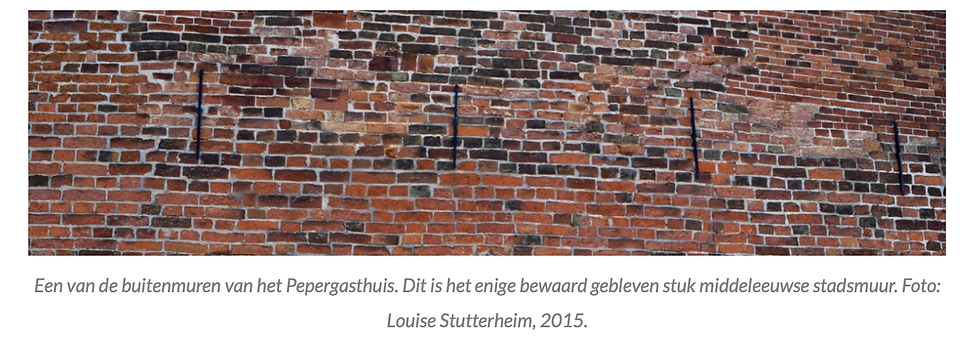
Exactly at the opposite side of the Via Vecchia you will find a small alley called "Achter de Muur" ("Behind the Wall"). If you want to know more about the history of the city, then we want to recommend you to take a look at this street where you can find a small part of the old city wall of Groningen.
In the 11th century there was a wall in this street that had to protect the city of Groningen against attacks from outside, which is why this street has been given the name 'Behind the Wall'. The city of Groningen has a long and rich history. Unfortunately, few traces of this rich past can still be found. Unfortunately, we have to disappoint anyone who is curious about the medieval city wall. Most of it has long since disappeared. If you still want to find traces, you need to know where to look. Groningen, like many other cities, was once surrounded by a wall that was supposed to protect it against attacks from outside. In the eleventh century, the city first got an earthen rampart (circa 1050). This wall was like a land defense: an earthen wall overgrown with shrubs, topped by wooden planks, posts and stakes, or stockades. Archaeological research has shown that parts of the rampart had already existed around 1025 – 1035. The wall, which was about four metres high, was given a dry moat (trench) about twenty metres wide immediately on the outside. Around 1260 the rampart was replaced by a stone wall that was about five to six metres high. This city wall was made of red brick and had a thickness of about 60-90 cm. On the inside of the city wall, a path ran all the way around the city. This was paved and given the name 'Behind the Wall'. Here in the street 'Behind the Wall' you can still find a small part of the city wall. Take a quick look at the photo and hopefully this will help you to find the wall in real life.
Via Vecchia:
This cozy street is a popular spot in the city. Translated from Italian, Via Vecchia means 'old street'.

Trompbrug (Tromp bridge):
