


Card 7
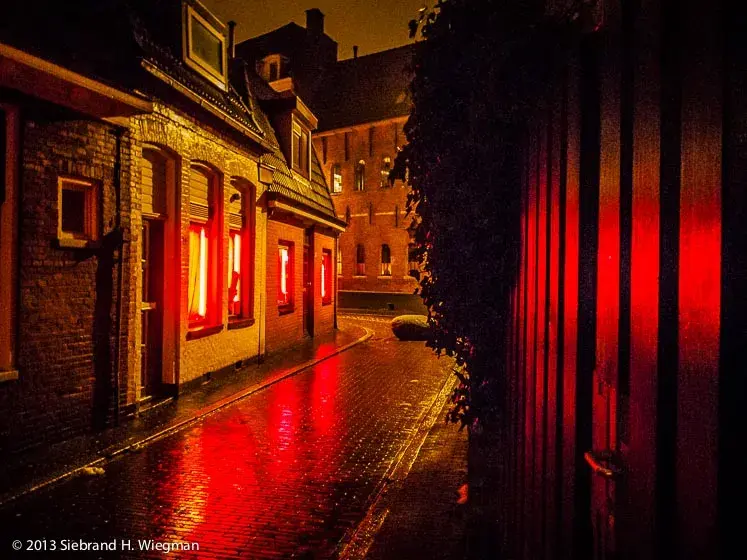
Rosse Buurt: (Red light district):
Back in the day you would find many prostitutes sitting behind the windows in this area. This former red-light district consisted of three streets: Hoekstraat, Muurstraat, and Vishoek. On December 31, 2015, the municipality decided to extinguish the red lights here due to ongoing issues with (drug-related) disturbances. In the Vishoek, you can find an artwork that was placed there as a tribute to the women who had shaped the image of the A-Kwartier for many years, the prostitutes. The artwork was created by artist Anne Wenzel and features a women's bust on a memorial column. A memorial column is erected to commemorate an important event or person and is intended to make an impression. The monument stands for women as human beings, with all their beauty, strength, and vulnerability.
Harmonie gebouw (Harmony building):
This building was a cultural complex located on Oude Kijk in't Jatstraat in the city of Groningen. Nowadays, it is the name of the university complex that was built on the same spot. The Sociëteit still exists and is one of the oldest associations in the province, founded in 1840. The original Harmonie building was constructed in 1856. In 1941, the upper floor was damaged by a fire. A proper renovation never took place, but the building continued to be used for concerts, sports events, exams, exhibitions, and parties for many years. Due to neglect, the Groningen City Council decided in 1973 that the complex had to be demolished. The citizens of Groningen were unhappy about this decision but couldn't prevent the demolition. The facade of the building was preserved and restored by architect Jo Kruger from Voorburg (facadism). The facade now serves as the front of the building that the University of Groningen moved into in 1980.
De Oude Kijk in ‘t Jatstraat: (The Old Look in't Jatstraat)
This street owes its name to the fact that in the year 1672, the city of Groningen was besieged. The fortification of Groningen was defended by Karel van Rabenhaupt. The Reitdiep, which was still an open sea inlet at the time, in other words 't Jat, served as an important supply route for food and weaponry. From a control post, a lookout kept watch over the Reitdiep and ensured that passage remained unobstructed. Every morning, when Van Rabenhaupt performed his inspection, the lookout would call out to him, "k Kiek nog in 't jat!" ("I'm still keeping an eye on the 't Jat!"). That's where the name De Oude Kijk in 't Jatstraat originates from.
Statue:
In front of the gates of the Harmoniegebouw, you will find the statue of the lady who became known as the first woman to be admitted to the university. This woman dedicated her life to advocating for women's suffrage and world peace. This is the statue of Aletta Jacobs, who was born in the Groningen village of Sappemeer in 1854. Jacobs started her studies at the University of Groningen in 1871. This statue was placed on this square in 1988 and was made by sculptress Theresia van der Pant.

RUG (University of Groningen):
This square is the epicentre of the student city of Groningen. It is home to the University Library on the one side and the Academy Building of the University of Groningen (RUG) on the other. The latter building was built in Renaissance style and given its appearance it is impossible to be missed. History teaches us that the first Academy Building dates back to the year 1613. This means that Groningen had one of the first universities in the country. With approximately 35,000 students, the University of Groningen is currently one of the largest Dutch universities. The Academy Building is one of the many locations of the University of Groningen. The building you see here dates from 1909 and was built after the previous academy building was almost completely destroyed by a fire three years earlier. Fortunately, not everything was lost then. With the help of citizens of Groningen, the portraits of professors, the University Archives and the banner of the Voluntary Student Company from the year 1665 were saved from the fire. This banner commemorates an important event in which almost all 120 students of the RUG volunteered to help defend the city against Bommen Berend (Bombs Berend) advancing into the City and surrounding area. Bommen Berend is the nickname of Christoph Bernhard Freiherr von Galen, the bishop of Münster. He lived from 1606 to 1678 and was of the opinion that Groningen and the surrounding area were part of his territory. When the Netherlands was attacked from all sides in 1672, the Bishop saw his chance to “get back” Groningen. He besieged and bombarded the city with bombs which he fired with a cannon. Because of his preference for this weapon, he soon got the popular name: Bommen Berend. On the 28th of August, Bommen Berend was defeated under the command of army commander Carl von Rabenhaupt.
Little Hidden church:
The Doopsgezinde Kerk (Mennonite Church) in Groningen is located in a side alley (click here) of the Oude Boteringestraat. Originally, there was a wooden clandestine church on this spot, concealed behind a residential house. The current church building was constructed after the Mennonites received full equal rights during the French era. The church was inaugurated on October 29, 1815. In the mid-nineteenth century, the building was expanded. After the front house was demolished, the church became visible from Oude Boteringestraat. This location reflects the former character of a hidden church.
Butjesstraat:
Did you know that the local word 'butje' originated in this street? If we want to make a proper comparison to the word 'butje', it corresponds to the word 'crazy' in English. In the Butjesstraat, there used to be a house that was used for children with disabilities, and they were often called 'BUTJES'. It is certainly not polite, but sometimes the local population still uses this word as an insult.
Prinsentuin (Prince's Garden):
As the Prinsentuin is completely enclosed by walls, you find yourself in an oasis of tranquility in the middle of the city center. In this Renaissance garden, you walk among box hedges, numerous rose beds, an herb garden, and leafy corridors. You will see a golden sun with a rod attached to it, and the shadow of the rod indicates the time. The maze of lines represents different meanings. The Prinsentuin was specially created in 1626 for the Princes of Nassau, who had the adjacent Prinsenhof as their local residence. Did you know that the Royal Family recently stayed here? Curious about when that was?