Card 2
Moi (hi)! You have just learned how Groningers greet each other. Did you know that Gronings is a dialect? A dialect is a regional language within the Dutch language. Did you think that Gronings is an easy dialect? One of the most famous Groninger of this moment, TikTok Tammo, will briefly explain to you that the Groningen dialect is not as easy as it seems ;)
We don't expect you to understand it, but now you have an idea of how the Groningen dialect sounds ;) Did you enjoy it?
Café Willem Albert:
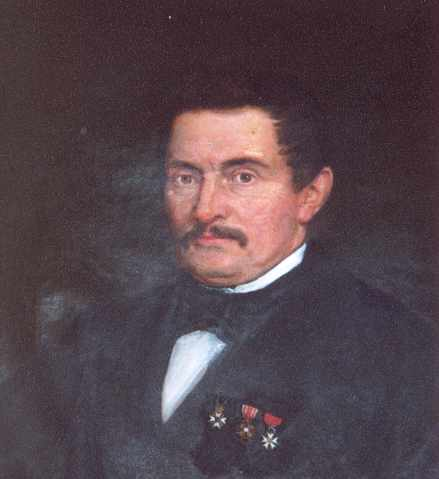
Willem Albert Scholten, a Groningen native who lived from 1819 to 1892, is regarded as the world’s first agricultural industrialist. He eventually established 24 factories producing potato starch, potato malt wine, strawboard, sugar, and peat litter. He built his factories both in the Netherlands and abroad, making him the Netherlands’ first industrial multinational and earning him a substantial fortune.
Willem Albert Scholten was determined to build his own palace in the heart of Groningen. He purchased three buildings on the Grote Markt, had them demolished, and then constructed his enormous house in an eclectic architectural style. In 1881, he and his family moved into the property he had built. However, the building also carries a heavy and tragic history. During the Second World War, the Scholtenhuis was seized by the Germans and used as the headquarters of the Sicherheitsdienst and the Sicherheitspolizei.

The house became known as “the antechamber of hell” because many resistance fighters were imprisoned, interrogated, and tortured there during the war. During the liberation of Groningen, the building was heavily shelled, set on fire, and ultimately destroyed.
Now, many years later, The Market Hotel has been built on this very spot.
Willem Albert Scholten
Naberstraat:
What is the story behind the name of the street where your city walk begins?It is closely connected to a man named Casper Naber, a resistance fighter who was imprisoned in the Scholtenhuis. Naber owned a hardware store in the city centre of Groningen, and under the codename “Clau”—French for “nail”—he operated a resistance radio post and helped Jewish people go into hiding. During a raid, Naber was arrested and taken to the Scholtenhuis, where he was interrogated and locked up in the attic. In the end, Naber took his own life by jumping from the attic window.
In the following short video by Groningse OOG TV, Naber’s story and the location of the building are briefly explained. The building can be seen from the Grote Markt
Martinitoren: (Tower)
The Martinitoren, also known as d' Olle Grieze (the Old Grey), gets its nickname from the fact that it is built with bricks covered in sandstone. This original yellow-brown stone gradually turns grey as it ages. The Martinitoren has endured many challenges, including various wars and fires. The original height of the Martinitoren was once 110 meters. Due to a lightning strike in 1627 and a subsequent fire, its height has been reduced to 96.8 meters. This makes the Martinitoren the tallest point in the city. Did you know that there is even an agreement that nothing in Groningen can be built higher than the Martinitoren? After World War II, the North and East walls of the Grote Markt were completely in ruins, but the Martinitoren remained standing proudly with only a few hits.
Grote Markt:
City Hall
The Grote Markt is the square surrounded by many of Groningen’s most characteristic buildings. At its center stands the City Hall. This neoclassical national monument first opened its doors in 1810 and was designed by architect Jacob Otten Husly. The building is the heart of Groningen’s political life. For more than 200 years, countless decisions have been made here. The City Hall was fully renovated and refurbished between 2020 and 2022.

The Goudkantoor
This beautiful building, constructed in Renaissance style, is located behind the City Hall and cannot be seen from the Grote Markt. It is definitely worth taking a moment to walk over and have a look. If you walk to the right around the City Hall from the Grote Markt, you will see the building directly in front of you. Built in 1635, it originally served as a tax office. The name Goudkantoor (“Gold Office”) comes from one of its later occupants: the Bureau of Assay of gold and silver works, which was housed on the upper floor from 1814 to 1887. Here, residents of Groningen could have their valuable items assessed and appraised.
In front of the building you will find the artwork “Appuntamento con la Musica”—also known as “Appointment with Music.” The flute player walks toward the new but looks back at the old. The artist’s symbolism represents the powerful energy of the past that propels and carries people into the present. To the left of the building you will find the bust of Carl von Rabenhaupt. This man played an important role in Groningen in 1672—a story we will return to later during the walk.

Redevelopment of the Grote Markt
In 2022, work began on a “new” layout for the Grote Markt. The redesign aimed to make the square more attractive for pedestrians and to create a pleasant place for people to meet. It may be hard to imagine now, but until recently buses, taxis, and cars circled the square daily. One of the goals of the redevelopment is to restore the Grote Markt as the city’s central square—its “beating heart.” A plaza where sitting, playing, meeting, celebrating, lingering, and passing through all come together.
During the redevelopment, archaeologists made several remarkable discoveries. The Grote Markt—formerly known as the Breede Merckt and already the city center of Groningen since the 11th century—revealed, among other things, a child’s grave from the early Middle Ages, a wall of the old Guardhouse (1509), medieval paving, a pilgrim’s ampulla, and a small lead phalanx (finger bone).


Star:
The star on the Grote Markt (in front of The Market Hotel) is actually a wind rose. This wind rose, made of brickwork, was designed in 1926 by city architect Jan Bouma. It refers to an even older wind rose that once lay on the north side of the Grote Markt and symbolized Groningen as a Hanseatic city.
A fun fact: there is a time capsule buried beneath the wind rose. You can find a stone within the wind rose that points to its presence. The capsule was placed in 1995 to mark the 50th anniversary of the liberation of the Netherlands. Inside the capsule are microfilms containing messages from residents of Groningen to their future fellow citizens.

Poelestraat: (Street)
This bustling street is full of restaurants and is transformed into a real nightlife area in the evening. These various essential catering establishments in this student city are a must-see. Did you know that about 25% of the inhabitants of Groningen are students? And that you can party in Groningen 24/7? There is always a pub open here and there are no closing times.
The Angels’ Gate (Poelestraat)
When you walk into the Poelestraat, you’ll find a remarkable historic gate between numbers 12 and 14, dating from the first half of the 17th century. The gate owes its name to the inn “De Blauwe Engel” (“The Blue Angel”), which once stood on the western corner of the Poelestraat. Originally, the gate connected the street to an inner courtyard near the Naberhof.
However, in 2012 the passage was closed due to the redevelopment of the area around the Grote Markt and the construction of Forum Groningen. After years of renovation and urban renewal, the Angels’ Gate was reopened in December 2020, showcasing how historical heritage and modern city development can go hand in hand. It now serves both as a practical passageway and as a beautiful piece of history in the heart of the city.

Achter de Muur (Behind the Wall):
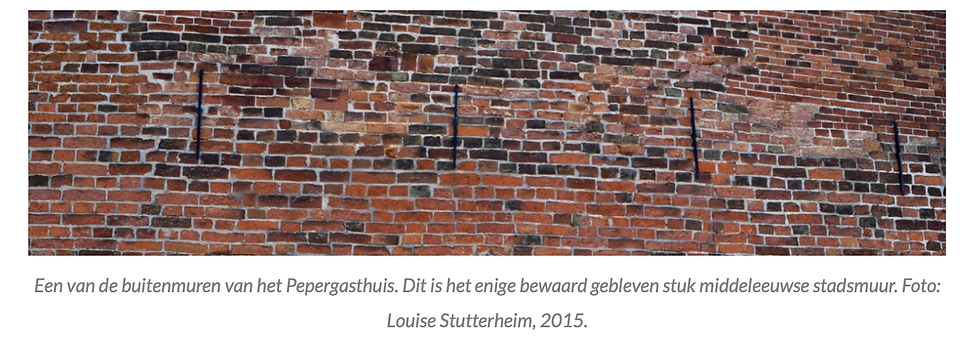
In the 11th century, there was a wall in this street that was meant to protect the city of Groningen from external attacks, which is why this street is named "Achter de Muur" (Behind the Wall). The city of Groningen has a long and rich history. Unfortunately, there are a few traces of this rich past left. Those who are curious about the medieval city wall will be disappointed as most of it has long disappeared. If you want to find any traces, you need to know where to look. Groningen, like many other cities, was once surrounded by a wall to protect it from external attacks. In the 11th century, the city initially had an earthen city rampart (circa 1050). This rampart was like an embankment covered with bushes, with wooden planks, poles, and stakes, known as palisades, on top. Archaeological research has shown that parts of the rampart already existed around 1025-1035. The wall, about four meters high, had a dry moat (ditch) of about twenty meters wide on the outside. Around 1260, the rampart was replaced by a stone wall, about five to six meters high. This city wall was made of red brick and had a thickness of about 60-90 cm. On the inside of the city rampart and the city wall, there was a path that ran all around the city. This path was paved and was called "Achter de Muur." Here in the street "Achter de Muur," you can still find a small section of the city wall. Take a look at the photo and hopefully, it will help you find the wall in real life.
Via Vecchia:
This cozy street is a beloved place in the city. Translated from Italian, Via Vecchia means "old street."
Trompbrug: (Trompbridge)
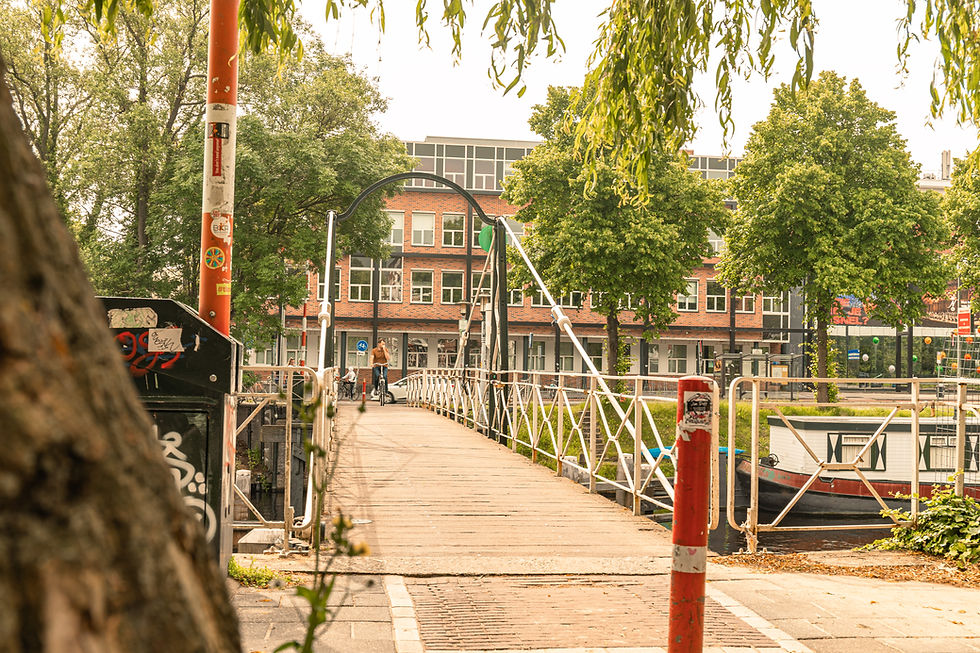
This bridge is called the Trompbrug and is known to many Groningers as the "bridge of love." This explains the padlocks you see hanging on the side of the bridge. Unfortunately, due to extensive maintenance work and transportation until February 2023, the many love locks have been removed. Besides being known as the bridge of love, the bridge also has other nicknames. The bridge is also called Klainbrugje (small bridge) or Kippenbrugje (chicken bridge), referring to the narrow width of the bridge.